






Japan: Cross-Border Collection Agency Services and “Agency Receipt”
We published a newsletter regarding Cross-Border Collection Agency Services and “Agency Receipt”. To view PDF version, please click the following link.
→Cross-Border Collection Agency Services and “Agency Receipt”
Cross-Border Collection Agency Services and “Agency Receipt”
— Practical Responses to the 2025 Amendment to the Payment Services Act
(Effective June 1, 2026) —
October 2026
One Asia Lawyers Group Tokyo Office
On June 1, 2026, the Act Partially Amending the Payment Services Act (Act No. 66 of 2025; the “Amendment Act”) came into force. As a result, collection agency services that cross national borders (“Cross-Border Collection Agency Services”) are now, in principle, treated as “exchange transactions” (kawase torihiki), and registration as a funds transfer service provider is required to conduct them. The related Cabinet Order and Cabinet Office Orders were also promulgated in May 2026, and the Financial Services Agency (the “FSA”) published its responses to public comments on May 22 of that month (Note 1).
Put simply, collection agency services have so far been kept outside the scope of regulation because, on the premise that the collecting party holds authority to receive payment on behalf of the payee (“Agency Receipt Authority”), the debtor’s obligation is discharged at the moment the funds are received. The amendment goes beyond this and imposes additional requirements. In this newsletter, we review this change and then explain what businesses should check, and how, now that the amendment is in force. Under the transitional measures, businesses may continue their operations without registration only until November 30, 2026, and must file their applications for registration by that date.
1.The Traditional Approach — Agency Receipt Authority and the “Risk of Double Payment”
A funds transfer service is the business of conducting exchange transactions by a person other than a bank or similar institution. Although “exchange transactions” are not defined by statute, case law has held that they mean accepting a request from a customer to transfer funds using a mechanism for moving funds between distant parties without directly transporting cash, or accepting and executing such a request.
A collection agency service is “an act of transferring funds from a debtor, etc. to a payee, etc. by receiving funds from the debtor, etc. as payment, or causing another person to receive them, upon entrustment from the payee or by any other similar method, and delivering such funds to the payee, etc.” Put simply, it is an arrangement in which the receipt of payments is entrusted to another party; examples include the payment of utility bills at convenience stores and cash-on-delivery services provided by delivery companies. Although such services are no different from remittances in that they move funds, they are well established in practice and, despite some debate, have traditionally been treated as outside the scope of the regulations on exchange transactions. The December 2019 report of a Financial System Council working group also concluded that there is little need to apply those regulations to collection agency services where (i) the creditor is a business operator or a national or local government, and (ii) it is clear from the contract that payment is completed when the debtor pays the collection agent, so that there is no risk of double payment (Note 2).
The basis for (ii) is the grant of Agency Receipt Authority by the creditor to the collection agent. If Agency Receipt Authority has been granted, payment is completed when the debtor pays the collection agent, and even if the collection agent subsequently fails, the debtor cannot be required to pay twice. Agency Receipt Authority has thus served as the substantive basis for placing collection agency services outside the regulations on exchange transactions.
2.Background to the Amendment
In contrast, under the Amendment Act, Cross-Border Collection Agency Services are, in principle, characterized as “exchange transactions” (Article 2-2, item (ii) of the Payment Services Act as amended (the “PSA”)).
Cross-Border Collection Agency Services are collection agency services in which funds move between Japan and another country. A typical example is where a Japanese business receives payments on behalf of an overseas seller. In such cases, too, the payee has often granted Agency Receipt Authority, and the outward structure is no different from that of domestic collection agency services (Note 3, p. 7). The FSA has identified the following examples through interviews with businesses (Note 3, p. 8):
|
Cross-Border Collection Agency Services have been brought within the regulations on exchange transactions because, unlike in domestic collection agency services, the prevention of double payment through Agency Receipt Authority may not function adequately in the cross-border context. Specifically, the FSA has pointed out that, because multiple intermediaries are involved, Agency Receipt Authority may not be properly established; that even where it is established, it is unclear which country’s law governs, making it uncertain whether it will be recognized as valid; and that payers may be forced to litigate abroad (Note 3, p. 10). The Financial System Council working group report (January 22, 2025) also notes the view that, even where Agency Receipt Authority has been granted, it is unclear whether payers can seek refunds of funds once paid (Note 4, p. 9, footnote 32). Where no Agency Receipt Authority has been granted in the first place, the act constitutes an exchange transaction (Note 4, p. 8, footnote 24). The Amendment Act therefore applies the regulations on exchange transactions to arrangements that perform substantially the same function as overseas remittances by banks and funds transfer service providers (Note 4, p. 8).
If your business falls under Cross-Border Collection Agency Services—or even if it merely appears similar to the examples above—it is advisable to begin reviewing it on the assumption that it may be covered.
The traditional approach remains unchanged after the amendment for collection agency services completed entirely within Japan (Note 4, p. 8, footnote 27).
3.Cross-Border Collection Agency Services Treated as “Exchange Transactions”
The Amendment Act treats as “exchange transactions” Cross-Border Collection Agency Services that satisfy all of the following requirements (i) through (iv) (chapeau and item (ii) of Article 2-2 of the PSA):
| (i) upon entrustment from the payee, or by taking an assignment of a monetary claim, etc., (ii) receiving funds from the debtor, etc. as payment, or causing another person to receive them, (iii) transferring the funds from the debtor, etc. to the payee, etc. by delivering them to the payee, etc., and (iv) the transfer of funds is from Japan to a foreign country or from a foreign country to Japan. |
The “payee” means a person holding a monetary claim; the “debtor, etc.” means the debtor or a person making payment upon entrustment from the debtor; and the “payee, etc.” means the payee or a person receiving payment upon entrustment from the payee.
The entrustment in (i) includes entrustment through multiple tiers (sub-entrustment).
Requirement (iv) is subject to exceptions prescribed by Cabinet Office Order; these are the exclusions discussed in Section 4 below.
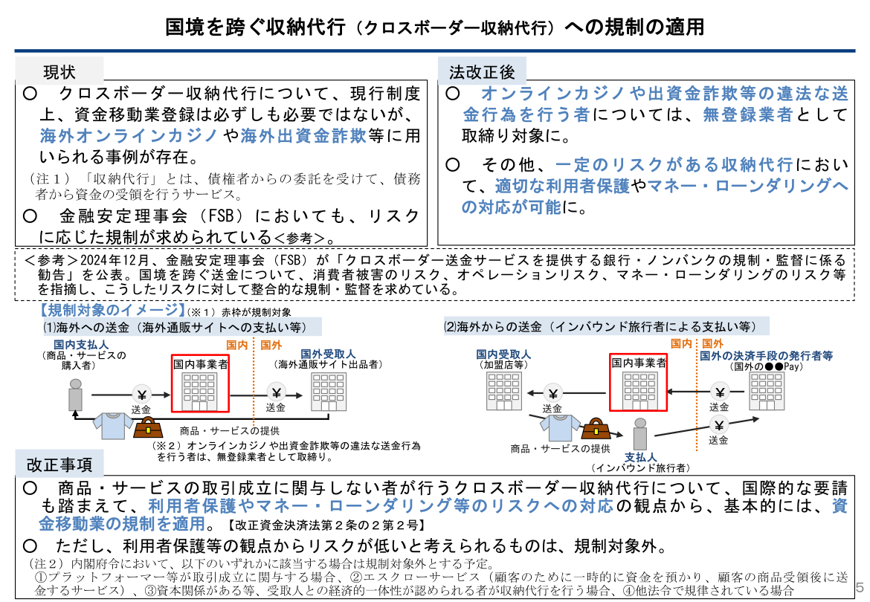
(Source: Note 5, p. 5)
The key point in practice is that this provision does not make the existence of Agency Receipt Authority a requirement. Even if the payee has properly granted Agency Receipt Authority, a transfer of funds across borders is, in principle, an exchange transaction. Agency Receipt Authority is no longer a sufficient basis for staying outside the regulations.
It should also be noted that whether a transfer is “from Japan to a foreign country” is not determined solely by the location of the parties. Because the determination depends on how the funds actually move, a transfer from a domestic bank account to an overseas bank account may be covered even where both the payee and the debtor are located in Japan (Administrative Guidelines (Volume 3: Financial Companies, 14. Funds Transfer Service Providers; the same applies hereinafter) I-2-2-1; Note 6). Conversely, even if a business is located overseas, the PSA applies if its acts are conducted in Japan (Note 7, No. 2).
Further, the FSA has stated that “an act of transferring funds upon entrustment, etc. from the debtor, etc. does not fall under the acts prescribed in Article 2-2 of the Payment Services Act, but may constitute an exchange transaction.” In other words, as is clear from the wording of the chapeau of Article 2-2 of the PSA, a transfer of funds upon entrustment, etc. from the payee is a requirement. Where the entrustment comes from the debtor, etc., the chapeau is therefore not satisfied, but whether the act constitutes an “exchange transaction” must be examined separately.
4.Exclusions
The relationship between Article 2-2, item (ii) of the PSA and Article 1-3 of the Cabinet Office Order on Funds Transfer Service Providers (the “FTSP Order”) can be organized into three tiers: the principle, the exceptions, and the exceptions to the exceptions. An overview is shown in the chart below.
| Principle | Cross-border collection agency services (chapeau and item (ii) of Article 2-2 of the PSA)
Constitute exchange transactions (registration as a funds transfer service provider required) |
| ▼ | |
| Exceptions | Acts falling under any of items (i) to (vii) of Article 1-3, paragraph 1 of the FTSP Order
Not exchange transactions (excluded) |
| ▼ | |
| Exceptions to the exceptions | Acts “posing a significant risk of insufficient user protection” under items (i) to (v) of Article 1-3, paragraph 2 of the FTSP Order
Not excluded; constitute exchange transactions as a matter of principle |
(1)Excluded Categories
Article 1-3, paragraph 1 of the FTSP Order excludes from regulation acts that fall under the chapeau and item (ii) of Article 2-2 of the PSA where they fall under any of the following items. Together with the points noted in the Administrative Guidelines and the public comment responses, they can be summarized as follows.
| Provision | Excluded category | Practical points |
| Item (i) | Collection agency services sub-entrusted to a bank, etc. or funds transfer service provider | The receipt of funds by the bank, etc. or funds transfer service provider must constitute receipt of payment in an exchange transaction conducted by it. Merely having payments made into an account in the business’s own name is insufficient (I-2-2-2(1)). |
| Item (ii) | Collection agency services incidental to escrow services | Funds are received before or at the same time as the payee’s counter-performance and delivered after the counter-performance. |
| Item (iii) | Collection agency services by providers of transaction platforms | “Involvement indispensable to the formation of the contract” is required, e.g., concluding sales contracts on behalf of sellers, or setting the conditions for the formation of transactions in the terms of use. Merely providing payment methods, advertising products, or introducing customers is insufficient (I-2-2-2(3)). Involvement limited to “intermediation,” such as solicitation or negotiation of terms, is also likely not to qualify (Note 8). |
| Item (iv) | Collection agency services where the payee belongs to the same corporate group | Said to cover not only parent-subsidiary relationships but also sister companies (Note 10). Not applicable where, e.g., claims are acquired from third parties for the purpose of evading regulation (I-2-2-2(4)). |
| Item (v)(a) | Collection agency services incidental to the settlement of third-party-type prepaid payment instruments, etc. by international brands | Eligible international brands are designated by public notice of the Commissioner of the FSA (I-2-2-2(5)). |
| Item (v)(b) | Collection agency services where the payee is a credit card merchant | It suffices that the transaction “can be” paid by card; actual payment by card is not required (I-2-2-2(6)). |
| Item (v)(c) | Collection agency services where the payee is a merchant accepting third-party-type prepaid payment instruments | It suffices that the transaction “can be” paid with a third-party-type prepaid payment instrument (I-2-2-2(7)). |
| Item (vi) | Collection agency services upon entrustment, etc. from persons conducting acts under item (ii) or (iii) | Premised on the entrusting party qualifying for the exclusion under item (ii) or (iii). Direct delivery to the payee, etc. is also permitted. |
| Item (vii) | Collection agency services upon entrustment, etc. from a bank, etc. or funds transfer service provider | ― |
(2)Cases Not Excluded — Where Agency Receipt Matters
Even acts falling under (1) are not excluded, and constitute “exchange transactions” under Article 2-2 of the PSA, if they are “acts posing a significant risk of insufficient user protection.” These are the acts listed in the items of Article 1-3, paragraph 2 of the FTSP Order, such as remitting stakes for online casinos. Among them, the following requirement applies to all of items (i) to (vii) in (1) and therefore warrants particular attention (Article 1-3, paragraph 2, item (i) and Article 1-2, item (i) of the FTSP Order):
“the debtor’s obligation relating to the monetary claim is not extinguished by the time the funds are received from the debtor, etc. … as payment (where another person is caused to receive the funds, by the time such other person receives the funds as payment)”
In other words, this refers to cases where the debtor’s payment is not completed when the funds are received. The provision in effect asks whether Agency Receipt Authority has been properly granted, and commentators understand it to target “cross-border collection agency services in which Agency Receipt Authority has not been properly granted” (Note 9).
The FSA has likewise stated that even acts falling under item (iii) (collection agency services by platform providers) are subject to the regulations on exchange transactions under paragraph 2, item (i) if Agency Receipt Authority has not been properly granted (Note 7, No. 40). Furthermore, if the debtor’s obligation is not discharged when funds are received by a person conducting item (vi) acts (collection agency services upon entrustment from an escrow or transaction platform provider), even the item (ii) or (iii) acts of the party causing that person to receive the funds become subject to regulation (Note 7, No. 87). If Agency Receipt Authority is not passed down to the entrusted party, the entrusting party also loses its exclusion.
In addition, the following are likewise not excluded: (a) in transfers of funds from debtors, etc. overseas to payees, etc. in Japan, acts where delivery of the funds to the payee may be impeded if the entrusted party becomes unable to perform its services properly (for example, where the platform provider’s liability is limited to the selection and supervision of the entrusted party; I-2-2-2(9)); (b) collection agency services relating to gambling; (c) collection agency services for claims arising from the acquisition or sale of securities or from derivatives transactions; and (d) acts violating laws or public policy similar to these. Note that even where the entrusting party loses its exclusion under (a), the item (vi) acts performed upon its entrustment remain outside the regulations (Note 7, No. 100), which differs from the treatment under paragraph 2, item (i).
5.Practical Steps
(1)Step 1: Map the Flow of Funds
First, for each payment in which your business is involved, chart who holds claims against whom, and through which accounts and to where the funds move. As noted in Section 3 above, for bank transfers, whether a transfer is domestic or cross-border is determined by the location of the accounts, so even transactions in which all parties are located in Japan may be covered. Flows involving overseas payment service providers or overseas group companies require particular attention.
(2)Step 2: Check Whether an Exclusion Applies
For each flow identified, check whether it falls under any of the items in the table in Section 4(1) above. The following two points are particularly prone to misunderstanding:
|
(3)Step 3: Confirm That Agency Receipt Authority Runs Through the Entire Chain
Even where an exclusion may apply, if Agency Receipt Authority has not been properly granted, the activity is subject to regulation as explained in Section 4(2) above. In Cross-Border Collection Agency Services, entrustment from the payee typically passes through multiple tiers. Is Agency Receipt Authority passed down without interruption from the payee to the person who actually receives the funds? Is the arrangement structured so that the debtor’s payment is completed when the funds are received? These two points need to be confirmed at the level of the contract documents.
(4)Step 4: Reflect the Results in Contracts and Terms of Use
The results of this review should be reflected in contracts and terms of use. In practice, the following points have been identified as key items for review (Notes 8 and 11):
|
(5)Step 5: If Registration Is Required
If no exclusion applies, registration as a funds transfer service provider is required. Funds transfer services are divided by the amount per transfer into Type I (registration plus approval of a business implementation plan; no upper limit), Type II (registration; up to JPY 1 million), and Type III (registration; up to JPY 50,000), and funds received from users must be fully safeguarded by deposit, guarantee, or trust. After registration, the business will be subject to verification at the time of transactions under the Act on Prevention of Transfer of Criminal Proceeds (the “APTCP”), as well as obligations under the Foreign Exchange and Foreign Trade Act and the Act on Submission of Statements of Overseas Wire Transfers for the Purpose of Securing Proper Domestic Taxation (the “Overseas Wire Transfer Reporting Act”). Where exchange transactions are conducted in the form of collection agency services, the “customer” under the APTCP is, in principle, the direct counterparty to the entrustment (e.g., an overseas payment service provider) (Note 7, No. 16).
Businesses already registered as funds transfer service providers must also take action if they conduct services not covered by an exclusion. A change in the type of business requires change registration (Article 41, paragraph 1 of the PSA), and a change in the content or method of business requires notification of the change (paragraphs 3 and 4 of the same Article) (Note 7, Nos. 130 and 131).
6.Deadline
Businesses that were already conducting acts constituting exchange transactions as a business at the time of enforcement may continue those operations without registration for six months from the effective date (until November 30, 2026) (Article 2, paragraph 1 of the Supplementary Provisions of the Amendment Act). If an application for registration is filed within this period, they may continue until a disposition granting or refusing registration is made, but not beyond two years from the effective date (i.e., not after May 31, 2028) (paragraph 2 of the same Article). During the transitional period, the obligations under the APTCP, the Foreign Exchange and Foreign Trade Act, and the Overseas Wire Transfer Reporting Act do not apply (Note 7, No. 132).
More than half of the transitional period has already elapsed. The FSA’s consultation counter for Cross-Border Collection Agency Services closed upon enforcement, and individual consultations are now handled, as with other PSA regulations, by the competent Local Finance Bureau or Local Finance Branch Office (Note 12). The government is to consider reviewing the scope of acts constituting exchange transactions, among other matters, approximately three years after enforcement (Article 9 of the Supplementary Provisions of the Amendment Act).
References (all in Japanese)
Note 1 FSA, “Promulgation of the Cabinet Order, etc. Relating to the 2025 Amendment to the Payment Services Act and Results of Public Comments” (May 22, 2026) https://www.fsa.go.jp/news/r7/sonota/20260522/20260522.html
Note 2 Financial System Council, Report of the “Working Group on Payment and Settlement Legislation and Financial Services Intermediary Legislation” (December 20, 2019) https://www.fsa.go.jp/singi/singi_kinyu/tosin/20191220/houkoku.pdf
Note 3 FSA, Secretariat explanatory materials for the 4th meeting of the Financial System Council “Working Group on Payment Systems, etc.” (November 7, 2024) https://www.fsa.go.jp/singi/kessaiseido_wg/siryou/20241107/1.pdf
Note 4 Financial System Council, Report of the “Working Group on Payment Systems, etc.” (January 22, 2025) https://www.fsa.go.jp/singi/singi_kinyu/tosin/20250122/1.pdf
Note 5 FSA, “Explanatory Materials on the Bill for the Act Partially Amending the Payment Services Act” (March 2025) https://www.fsa.go.jp/common/diet/217/02/setsumei.pdf
Note 6 FSA, “Partial Amendment to the Administrative Guidelines (Volume 3: Financial Companies, 14. Funds Transfer Service Providers) (Comparison Table)” (May 22, 2026) https://www.fsa.go.jp/news/r7/sonota/20260522/24.pdf
Note 7 FSA, “Summary of Public Comments and the FSA’s Views (Cross-Border Collection Agency Services)” (May 22, 2026) https://www.fsa.go.jp/news/r7/sonota/20260522/04.pdf
Note 8 Okazaki (岡﨑頌央), “Overview of the Regulations on Cross-Border Collection Agency Services in Light of the Public Comments,” Business & Law (August 14, 2026) https://businessandlaw.jp/articles/a20260814-1/
Note 9 Takashi Osawa, “Publication of Draft Cabinet Office Orders, etc. on Funds Transfer Services Relating to Cross-Border Collection for Public Comment,” Ushijima & Partners (December 22, 2025) https://www.ushijima-law.gr.jp/client-alert_seminar/client-alert/20251226fundstransfer/
Note 10 TMI Associates, “Commentary on the Regulations on Cross-Border Collection Agency Services” (August 27, 2026) https://www.tmi.gr.jp/eyes/blog/2026/18745.html
Note 11 Masayuki Watanabe, “A Complete Guide to the Regulation of Global Collection Agency Services: A Practical Manual for the Amended Payment Services Act and the FTSP Order,” Miyake & Partners (May 25, 2026)
Note 12 FSA, “Closure of the Consultation Counter for Cross-Border Collection Agency Services” (May 22, 2026) https://www.fsa.go.jp/news/r7/sonota/20260522-3/20260522-3.html