






Navigating ESG in Malaysia: A Legal and Strategic Guide for Corporations
We published a newsletter regarding Navigating ESG in Malaysia: A Legal and Strategic Guide for Corporations. To view PDF version, please click the following link.
→Navigating ESG in Malaysia: A Legal and Strategic Guide for Corporations
Navigating ESG in Malaysia:
A Legal and Strategic Guide for Corporations
May 2025
One Asia Lawyers Group
Yuki Hashimoto Lawyer (Japan)
Sharil Ramli Lawyer (Malaysia)
1. Introduction
Environmental, Social, and Governance (ESG) considerations have transitioned from corporate buzzwords to core strategic imperatives. In Malaysia, ESG is gaining prominence amid evolving global expectations, domestic regulatory reforms, and stakeholder pressure. Corporations, especially listed entities must now integrate ESG into their business models, risk management frameworks and compliance programs.
To date, there is no universally accepted definition of ESG. The ambiguity surrounding ESG criteria presents significant challenges for compliance, as companies may struggle to interpret and implement these principles consistently. As a result, ESG compliance largely depends on the standards or benchmarks established by regulatory bodies within each respective country.
This article offers a legal roadmap for corporations in Malaysia to navigate the ESG landscape, focusing on regulatory frameworks, key disclosure obligations and strategic implementation considerations.
2. ESG Defined: The Malaysian Context
ESG encompasses three interconnected pillars:
- Environmental: Resource use, climate change and pollution.
- Social: Labour practices, community impact, human rights, diversity and inclusion.
- Governance: Board diversity, anti-corruption, risk management, and stakeholder engagement.
In Malaysia, ESG is driven by both top-down regulation and bottom-up market demand, aligning with global frameworks such as the United Nations Sustainable Development Goals (SDGs), the Task Force on Climate-related Financial Disclosures (TCFD), and the Global Reporting Initiative (GRI).
3. Legal and Regulatory Framework
(a) Bursa Malaysia’s Sustainability Reporting Requirements
Under the Main Market Listing Requirements (MMLR) and ACE Market Listing Requirements, listed issuers are required to publish a Sustainability Statement in their annual reports. The key elements include:
- Materiality Assessment: Include a narrative statement of the management of material ESG risks and opportunities relevant to the business and stakeholders.[1]
- Governance Structures: Describe how ESG is managed at board and management levels.
- Stakeholder Engagement: Disclose how the company engages with stakeholders on ESG.
- Performance Indicators: Report on qualitative and quantitative ESG data.
Bursa Malaysia also published the Sustainability Reporting Guide to assist public listed companies to comply with Bursa Malaysia’s Listing Requirements when producing a Sustainability Statement in their annual reports. The Sustainability Reporting Guide also includes case studies from publicly listed companies on Bursa Malaysia, offering practical examples and insights.
The Sustainability Reporting Guide provides guidance to public listed companies in Malaysia, among others, in the following areas:
- Establishing a governance structure to oversee sustainability efforts;
- Defining the scope of the Sustainability Statement, including the rationale behind its boundaries;
- Conducting a comprehensive materiality assessment to systematically identify and prioritize sustainability issues most relevant to the company and its stakeholders;
- Setting and communicating performance targets to reflect the company’s sustainability goals, strategic direction, and progress;
- Ensuring the Sustainability Statement undergoes an assurance process; and
- Aligning disclosures with the recommendations of the Task Force on Climate-related Financial Disclosures (TCFD).
(b) Malaysian Code on Corporate Governance (MCCG)
The Malaysian Code on Corporate Governance (MCCG), issued by the Securities Commission Malaysia, outlines a set of principles and recommendations designed to encourage strong corporate governance practices among companies. The MCCG highlights on the following areas:
- Board Oversight of ESG: A public listed company listed on Main Market or ACE Market of Bursa Malaysia must ensure its board of directors provides an overview of the application of the principles set out in the MCCG, in its annual reports.[2] Boards should possess a comprehensive understanding of ESG issues pertinent to their business. This includes staying informed about climate-related risks and opportunities, and identifying any gaps in skills or knowledge that may hinder effective oversight. The MCCG also focuses on the responsibilities to implement ESG within the companies;
- Strategic Communication of ESG Efforts: Companies must ensure that their sustainability strategies, priorities, and performance metrics are effectively communicated to both internal and external stakeholders, promoting transparency and accountability[3];
- Inclusion of ESG in Performance Evaluations: The performance assessments of both the board and senior management should encompass their effectiveness in managing sustainability risks and opportunities, aligning their incentives with long-term ESG objectives.[4]
(c) Bank Negara Malaysia’s Climate Risk Initiatives
For financial institutions, Bank Negara Malaysia (BNM) introduced the Climate Change and Principle-based Taxonomy (CCPT) and Value-Based Intermediation (VBI) frameworks. These initiatives aim to steer financial institutions towards sustainable practices, aligning with national and global climate objectives.
Climate Change and Principle-based Taxonomy (CCPT)
Launched in April 2021, the CCPT provides a structured approach for financial institutions to assess and classify economic activities based on their environmental impact. The taxonomy is grounded in five guiding principles[5]:
- Climate Change Mitigation: Activities that reduce or prevent greenhouse gas
- Climate Change Adaptation: Actions that enhance resilience to climate-related impacts.
- No Significant Harm: Ensuring activities do not adversely affect environmental or social outcomes.
- Remedial Measures: Implementing corrective actions for activities causing significant harm.
- Prohibited Activities: Activities that are illegal or contravene environmental laws.
Value-Based Intermediation (VBI) Framework
The VBI framework, introduced in 2017, aligns Islamic financial institutions with Shariah principles and sustainable development goals. In 2020, BNM further developed the Value-based Intermediation Financing and Investment Impact Assessment Framework (VBIAF), providing sector-specific guidelines to enhance the effectiveness of VBI. ESG-wise, it emphasizes on:
- Impact Assessment: Evaluating the social and environmental outcomes of financing activities.[6]
- Stakeholder Value: Prioritizing benefits to society and the environment over mere financial returns.[7]
- Sustainable Financing: Directing funds towards projects that promote long-term societal welfare.
(d) Securities Commission Malaysia’s (SC) Sustainable and Responsible Investment (SRI) Roadmap 2019-2025
The SC’s Sustainable and Responsible Investment (SRI) Roadmap 2019-2025 promotes ESG adoption in the capital market. The SC has introduced 5 SRI strategies to develop a facilitative SRI ecosystem in the Malaysian capital market, as shown in the illustration below. These strategies serve to expand the range of SRI instruments, issuers, investors and ancillary services, while strengthening disclosure and governance by drawing synergies from our existing global leadership in the closely-aligned field of Islamic finance.
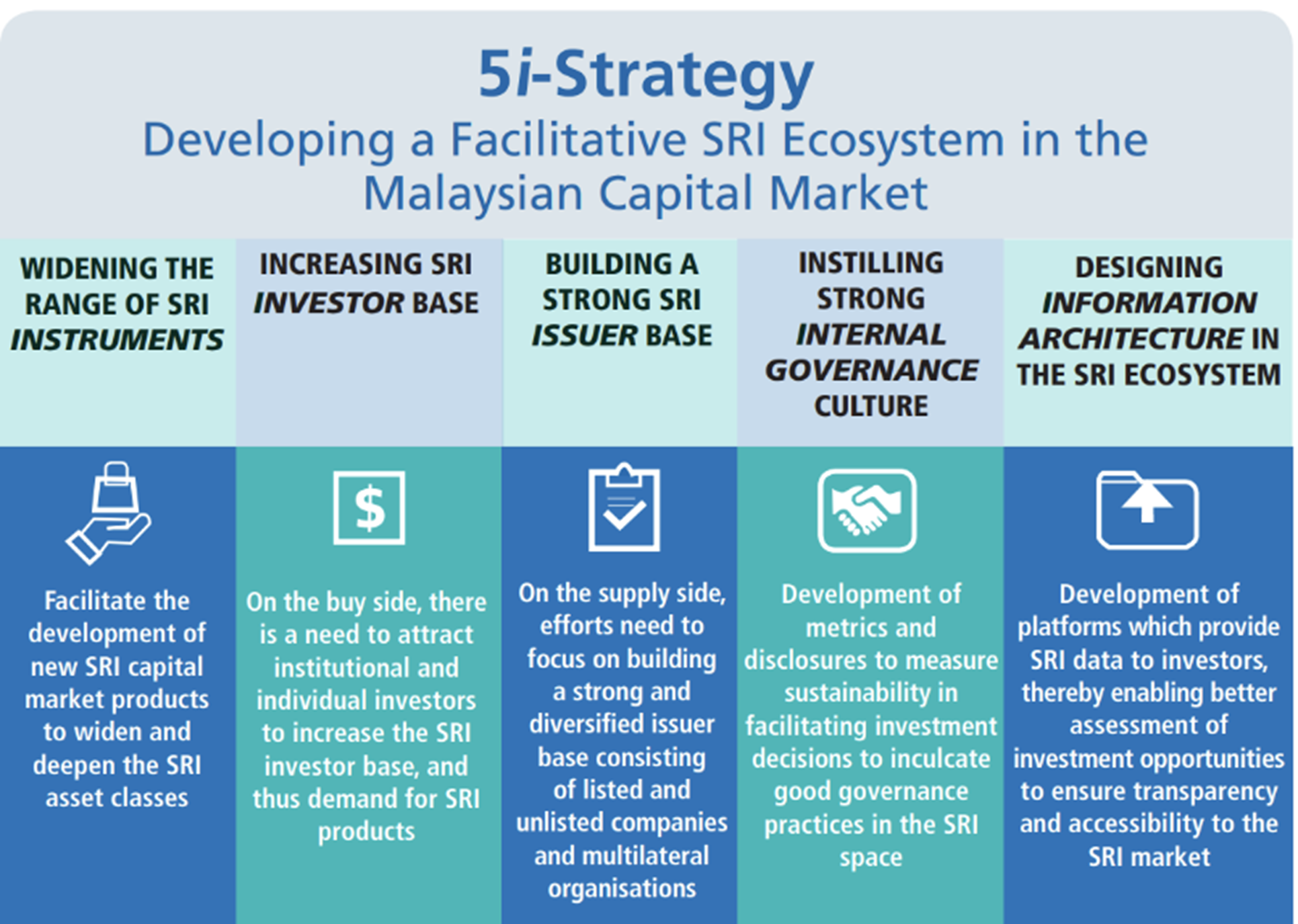
Source: Paragraph 1.3, Sustainable and Responsible Investment Roadmap for The Malaysian Capital Market, Securities Commission Malaysia
4. Strategic Considerations for Corporations
Below, we explore three strategic focus areas that corporate boards and management must address to stay ahead of ESG-related developments.
(a) Board and Management Readiness
Strong leadership is foundational to any ESG initiative. Boards must be equipped with the right governance structures and skillsets to provide strategic oversight. We advise a corporation to consider appointing a dedicated Chief Sustainability Officer or forming an ESG Committee at the board level to drive implementation and accountability. Directors should be trained to understand ESG risks and how these intersect with their fiduciary duties under the Companies Act 2016 and corporate governance codes such as the MCCG. Further, corporations should also embed ESG-linked Key Performance Indicators (KPIs) in executive remuneration and performance reviews to align management incentives with long-term sustainability goals.
(b) Legal Risk Assessment and Compliance
ESG compliance requires a proactive legal risk review across operations. The legal team can review existing and new contracts to incorporate ESG-related provisions, such as sustainability-linked covenants, audit rights, and termination triggers for ESG breaches. Corporations should also conduct due diligence and perform internal audits to ensure compliance with environmental legislation e.g., the Environmental Quality Act 1974, Employment Act 1955 and anti-bribery provisions under the Malaysian Anti Corruption Commission (MACC) Act 2009.
(c) Disclosure and Assurance
Sustainability reporting is fast becoming a compliance obligation, particularly for public listed companies under Bursa Malaysia’s disclosure requirements. We recommend that corporations enhance their disclosure obligations by alligning disclosures with internationally recognised frameworks such as the Global Reporting Initiative (GRI) and Sustainability Accounting Standards Board (SASB) and engaging independent assurance providers to verify ESG disclosures, thereby enhancing credibility and investor confidence. Where feasible, corporations should publish a comprehensive ESG report separate from the annual report to highlight the organisation’s sustainability commitments.
5. Conclusion
In conclusion, as ESG principles continue to evolve from voluntary guidelines to mandatory regulatory requirements, corporations in Malaysia must recognize that integrating ESG into their business strategies is not just a compliance obligation, but a vital component of long-term success.
The board and management play vital roles in guiding companies through the complexities of ESG regulations, ensuring robust governance structures, managing legal risks, and maintaining transparency in reporting. With increasing pressure from stakeholders, the strategic integration of ESG factors will not only protect corporate reputation but also unlock new opportunities for growth and resilience. The time to act is now, corporations that embrace ESG as a core business value will be better positioned to navigate the challenges of today’s rapidly changing business landscape.
If you have any questions or require further assistance on ESG and other topics, please do not hesitate to contact us.Top of Form
—–
[1] Paragraph 29, Part A of Appendix 9C of Main Market Listing Requirements and Paragraph 30, Part A of Appendix 9C of ACE Market Listing Requirements
[2] Paragraph 15.25 of the Main Market Listing Requirements and Rule 15.25 of the Ace Market Listing Requirements
[3] Paragraph G1.1, Principle A, MCCG
[4] Paragraph G4.1, Principle A, MCCG
[5] Implementation Progress of the Climate Change and Principle based Taxonomy (CCPT) in the Financial Sector, Financial Stability Review 2022, Bank Negara Malaysia
[6] Paragraph 32, Page 21, Value-based Intermediation Financing and Investment Impact Assessment Framework Guidance Document, BNM
[7] Paragraph 5, Page 5, Value-based Intermediation Financing and Investment Impact Assessment Framework Guidance Document, BNM