






Japan: Amendments to the Subcontract Acts
We published a newsletter regarding the Amendments to the Subcontract Acts in Japan. To view PDF version, please click the following link.
→Amendments to the Subcontract Acts
Amendments to the Subcontract Acts
September 22, 2025
One Asia Lawyers Group Tokyo Office
Bakuto Yamamoto, Lawyer (Japan)
Yugo Kusu, Lawyer (Japan)
The “Bill to amend the Subcontract Act and the Act on the Promotion of Subcontracting Small and Medium-sized Enterprises”(下請代金支払遅延等防止法及び下請中小企業振興法の一部を改正する法律) was enacted on May 16, 2025, and promulgated on May 23, 2025. Accordingly, the “Act against Delay in Payment of Subcontract Proceeds, etc. to Subcontractors” ((下請代金支払遅延等防止法) commonly referred to as the “Subcontract Act” (下請法)) will be revised and renamed as the “Act Against Delay in Payment of Fees, etc. to Small and Medium-sized Entrusted Business Operators in Manufacturing and Other Specified Fields” ((製造委託等に係る中小受託事業者に対する代金の支払の遅延等の防止に関する法律) abbreviated as the “取適法,” hereinafter, the Act against Delay in Payment of Subcontract Proceeds, etc. to Subcontractors will be referred to as the “Current Act”, and the “Act Against Delay in Payment of Fees, etc. to Small and Medium-sized Entrusted Business Operators in Manufacturing and Other Specified Fields” will be referred to as the “Amended Act”). The Amended Act will come into effect on January 1, 2026.
Under the Current Act, periodic investigations and on-site inspections are conducted by the Japan Fair Trade Commission and the Small and Medium Enterprise Agency, and in cases of certain violations, recommendations are issued, company names are disclosed, and fines may be imposed. Therefore, whether or not violating the Current Act is extremely important for businesses, and the same applies under the Amended Act. In addition, in 2024, the number of guidance cases under the Current Act was 8,230, and as a result of restitution for disadvantages suffered by subcontractors, 149 principal contractors restored subcontract proceeds or equivalent amounts to 3,026 subcontractors, totaling JPY 1,352,790,000[1]. Given that the Amended Act expands the scope of application compared to the Current Act, adds prohibited acts, and allows guidance by the relevant administrative agencies, understanding the Amended Act is essential. The following explains the overview of the amendment.
1. Contents of the Amendment
1.1 Changes in Terminology
| Before Amendment | After Amendment |
| Act against Delay in Payment of Subcontract Proceeds, etc. to Subcontractors | Act Against Delay in Payment of Fees, etc. to Small and Medium-sized Entrusted Business Operators in Manufacturing and Other Specified Field |
| Subcontract proceeds | To be determined (In Japanese “製造委託等代金”) |
| Main subcontracting business operators | Entrusting business operators |
| Subcontractors | Small and medium-sized entrusted business operators |
1.2 Major Items of Amendment
• Changes in the Definition of Main subcontracting business operators and Subcontractors
In addition to the previous capital criterion, an employee criterion has been added.
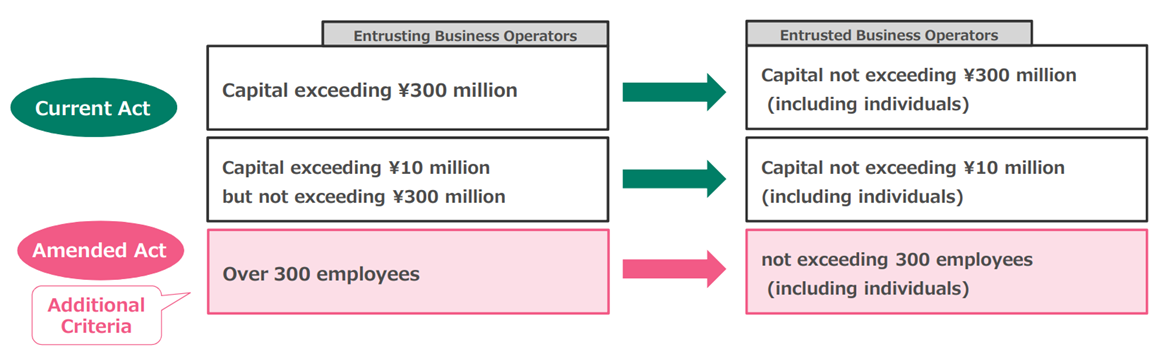
(The above table concerns the Manufacturing Contract, and the above table is from “Summary of the Act to amend the Subcontract Act and the Act on the Promotion of Subcontracting Small and Medium-sized Enterprises”[2])
• Expansion of Scope of Application
A new type of transaction, in which the shipper entrusts the transportation of goods to logistics companies, as a new type covered by the Amended Act
• Addition of Prohibited Acts
◦ Prohibition of Determination of Price without Proper Negotiation
(Amended Act, Article 5, Paragraph 2, Item 4)
・Prohibiting unilateral price determination, thereby unfairly harming the interests of small and medium-sized entrusted business operators, such as refusing to engage in price negotiations despite requests from small and medium-sized entrusted business operators or failing to provide necessary explanations or information.
◦ Prohibition of Payment by Promissory Note, etc.
(Amended Act, Article 5, Paragraph 1, main clause, and Paragraph 1, Item 2)
・In order to protect small and medium-sized entrusted business operators, promissory notes shall not be permitted as a means of payment under this Act.
・With regard to Electronically Recorded Monetary Claims, etc., those for which it is difficult to obtain the full amount including fees, etc. by the payment date shall not be permitted under Amended Act.
• Strengthening Enforcement
◦ New provisions have been established regarding guidance and advice from relevant administrative agencies.
◦ In order to ensure an environment in which small and medium-sized entrusted business operators can easily report violations, “Prohibition of Retaliatory Measures” will be extended to include reporting to the relevant administrative agencies, in addition to the current reporting to the JFTC and the Small and Medium Enterprise Agency.
• Obligation to Pay Late Interest
◦ Adding Reduction to the amount subject to late interest, and if the amount of the payment is reduced, late interest shall be paid for the period from the date 60 days after the commencement date to the date of actual payment [Related to new Article 6(2)]
• Flexibility in Electronic Delivery of Orders
◦ With regard to the obligation to Deliver Document, the required statements can be provided by electronic or magnetic means, with or without the consent of the small and medium-sized entrusted operators [Related to new Article 4]
• Addition of Objects Subject to Manufacturing Contract
◦ Wooden molds, jigs, etc. used exclusively for the creation of products are to be added as objects of Manufacturing Contract in the same way as molds [Related to new Article 2(1)]
2. Important Points of the Amendments
2.1 Changes in the Definition of Main subcontracting business operators and Subcontractor
2.1.1 The background of the amendments is that, for each business including SMEs to secure resources for wage increases, it is important to establish proper price transfer throughout the supply chain. Therefore, eliminating trade practices that hinder price transfer and shift burdens to contractors is necessary to ensure proper transactions.
2.1.2 The previous capital criterion sometimes excluded enterprises that were substantively large but had low initial capital or allowed principal contractors to evade the Current Act by requesting capital increases from contractors. Therefore, an employee criterion has been added in addition to the capital criterion.
By adding employee criterion in addition to capital requirement for such entrusting business operators, the scope of enterprises newly subject to the Amended Act may expand. Specifically, it is anticipated that enterprises which no longer meet the capital requirement due to capital reduction, or companies organized as limited liability companies (e.g., certain foreign-affiliated companies) that have low capital but conduct substantial business activities, may become newly subject to regulation[3].
2.1.3 Verification of employee numbers will now be necessary in transactions.
2.2 Entrustment the Transportation of Goods added to the new scope of regulation
2.2.1 Entrustment from the shipper to the primary carrier is not covered by the Current Act. Problems between shippers and logistics companies are becoming apparent, such as weak logistics companies being forced to perform loading and unloading and waiting for cargo free of charge.
2.2.2 Therefore, entrustment the transportation of goods added to the new scope of regulation in the Amended Act.
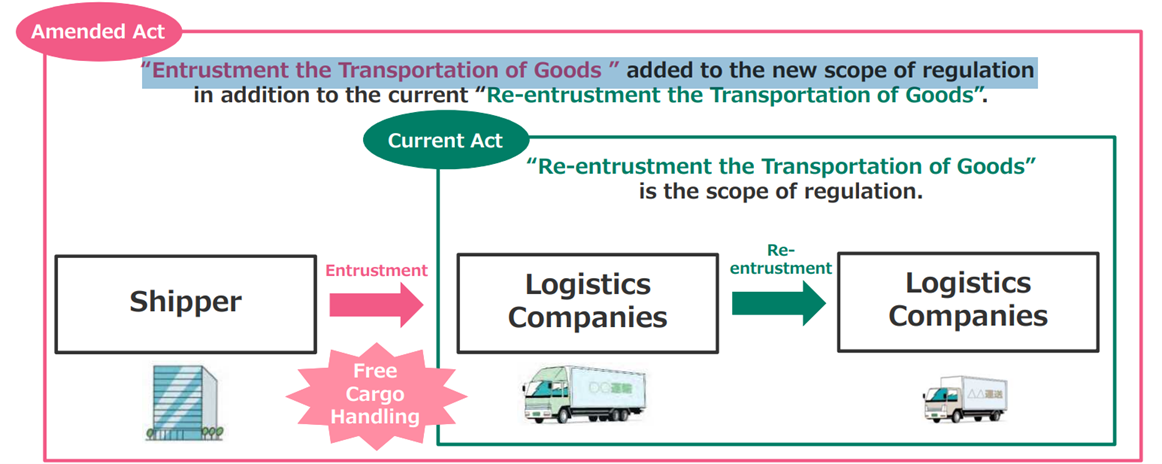
(From “Summary of the Act to amend the Subcontract Act and the Act on the Promotion of Subcontracting Small and Medium-sized Enterprises[4]”)
2.3 Prohibition of Payment by Promissory Notes, etc
2.3.1 Due to rising costs, problems arose such as fixing prices without consultation or unilaterally deciding prices insufficient to cover increased costs. To ensure proper price transfer, it is now prohibited for entrusting business operators to determine contract proceeds unilaterally when small and medium-sized entrusted business operators request consultation or explanation.
2.3.2 Examples of violations include:
◦ A transport company (entrusting business operators) ignoring, refusing or delaying consultation requests from a transport company (medium-sized entrusted business operators) regarding price increases.
◦ A machinery manufacturer (entrusting business operators) reducing subcontract price without providing specific reasons or supporting materials in response to a part manufacture’s (medium-sized entrusted business operators) request for explanation.
2.4 Flexibility in Electronic Delivery of Orders
2.4.1 Under the Current Act, main subcontracting business operators had to provide order details in writing, with electronic provision allowed only with the subcontractor’s consent.
2.4.2 Under the Amended Act, required information may now be provided electronically regardless of consent from the medium-sized entrusted business operators, improving convenience for contracting enterprises.
3. Reference Materials
- Japan Fair Trade Commission and Small and Medium Enterprise Agency, “Summary of the Act to amend the Subcontract Act and the Act on the Promotion of Subcontracting
- Small and Medium-sized Enterprises” May 2025
https://www.jftc.go.jp/file/250516/Attachment2.pdf - Japan Fair Trade Commission and Small and Medium Enterprise Agency, “the Act to amend the Subcontract Act and the Act on the Promotion of Subcontracting Small and Medium-sized Enterprises”
- https://www.jftc.go.jp/file/250516/Attachment1.pdf
- Japan Fair Trade Commission and Small and Medium Enterprise Agency, “Regarding the passage of the Act to amend the Subcontract Act and the Act on the Promotion of Subcontracting Small and Medium-sized Enterprises”, May 16, 2025
https://www.jftc.go.jp/file/250516.pdf
—–
[1] https://www.jftc.go.jp/houdou/pressrelease/2025/may/250512.html (Japanese only)
[2] Japan Fair Trade Commission and Small and Medium Enterprise Agency, “Summary of the Act to amend the Subcontract Act and the Act on the Promotion of Subcontracting Small and Medium-sized Enterprises” May 2025, p. 8.
[3] Koji Mukai and Tetsuya Nagasawa, “From the Act against Delay in Payment of Subcontract Proceeds, etc. to Subcontractors to Act Against Delay in Payment of Fees, etc. to Small and Medium-sized Entrusted Business Operators in Manufacturing and Other Specified Field-Approaching the purpose of the Amentments”, NBL No.1297 (September 1, 2025), p.16.(Japanese only)
[4] Japan Fair Trade Commission and Small and Medium Enterprise Agency, “Summary of the Act to amend the Subcontract Act and the Act on the Promotion of Subcontracting Small and Medium-sized Enterprises” May 2025, p. 7.