






AI Laws and Guidelines Around the World -Part 2: ASEAN-
We published a newsletter regarding AI Laws and Guidelines Around the World. To view PDF version, please click the following link.
→AI Laws and Guidelines Around the World -Part 2: ASEAN-
AI Laws and Guidelines Around the World
-Part 2: ASEAN-
January 2026
One Asia Lawyers Group
AI Legal Practice Group
Yusuke Tomofuji, Lawyer (New York, USA)
1. Introduction
Following the part 1 of the newsletter on AI Laws and guidelines around the world which discussed Indonesia’s AI-related guidelines, this part 2 edition introduces the ASEAN Guide on AI Governance and Ethics which was published in 2024. The background and purpose of this newsletter series are explained in the opening section of the part 1 edition[1].
2. ASEAN Guide on AI Governance and Ethics
(1) Overview
In February 2024, ASEAN released the ASEAN Guide on AI Governance and Ethics (hereinafter, the “Guideline”)[2]. The Guideline is not legally binding; rather, it serves as a common reference framework for governments and organizations to design, develop, and deploy AI systems in a safe and ethical manner.
The Guideline adopts a risk-based approach which may have referred to the European model to some extent. The Guideline classifies risks into low, medium, and high based on the likelihood and potential impact of harm. However, the following major aspects of EU AI Act are not introduced:
– categories of unacceptable-risk AI systems prohibited outright, or
– specific definitions identifying which AI systems fall into “high-risk” categories.
(2) Structure of the Guideline
The Guideline consists of the following components:
- Executive Summary
- Introduction
- Guiding Principles for the Framework
- AI Governance Framework
- National-Level Recommendations
- Regional-Level Recommendations
- Conclusion
- Annex A: AI Risk Impact Assessment Template
- Annex B: Use Cases (Reference Examples)
- A summary of each section is provided below.
(3) Purpose of the Guideline (Section A.1)
The ASEAN AI Guideline aims to promote responsible AI adoption across the region. Its principal objectives are as follows:
– Providing guidance to governments
Encouraging ASEAN Member States to refer this Guideline when formulating national AI-related policies, including design, development, and deployment aspects.
– Providing practical guidance for private organizations
Serving as a practical guide for organizations in ASEAN when designing, developing, and deploying AI systems.
Regarding the latter objective – providing guidance for private organizations-, the Guideline particularly encourages them to build public trust by introducing the Guideline’s risk assessment methods so that they can properly assess AI-related risks and implement appropriate mitigation measures.
The Guideline is expressly positioned as a “living document”, which will be periodically updated in light of technological developments and regulatory progress in the AI space.
(4) Guiding Principles (Section B)
The Guideline sets out seven guiding principles that organizations should observe when designing and operating AI systems. Their contents are summarized below.
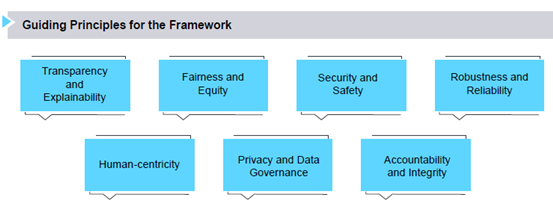
a. Transparency & Explainability
– Transparency – transparency on the followings-;
- When AI is used
- Extent of AI involvement in decision-making
- Data used by AI
- Purpose of AI use
– Explainability: Maintain the ability to explain the rationale behind AI-driven decisions.
b. Fairness & Equity
Implement safeguards to prevent:
- Amplification of existing discrimination across demographic groups
- Biases or unfair outcomes arising from AI design, development, or deployment.
c. Security & Safety
– Implement cybersecurity and other protective measures against AI-specific threats (e.g., data poisoning, model inversion, dataset manipulation).
– Conduct impact and risk assessments to identify and mitigate known risks.
d. Human-Centricity
– Ensure that AI respects human-centric values and promotes human welfare, wellbeing, and societal benefit.
e. Privacy & Data Governance
– Put in place mechanisms to protect:
- data privacy and security
- data quality and integrity.
f. Accountability & Integrity
– Ensure accountability for AI-driven decisions, compliance with applicable laws, and adherence to AI ethics and principles.
– Act with integrity throughout the AI system lifecycle.
g. Robustness & Reliability
– Ensure systems function consistently and reliably across a wide range of conditions.
(5) AI Governance Framework for Organizations (Section C)
The Guideline identifies four governance areas that organizations should establish:
a. Internal Governance Structures
AI Ethics Board: The Guideline recommends a multidisciplinary committee to address complex ethical issues.
Layered governance structures proportionate to the level of AI risk, with stronger controls for high-risk systems.
b. Determining the Level of Human Involvement in AI Decision-Making
Based on risk evaluation (low/medium/high likelihood and impact), human involvement should be categorized as follows:
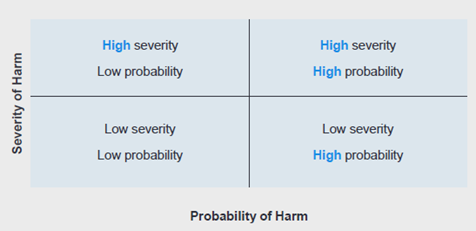
– Human-in-the-loop: Humans make the final decision; AI provides supportive information (e.g., clinical diagnosis support).
– Human-over-the-loop: AI operates autonomously, but humans can intervene when anomalies occur (e.g., autonomous driving systems).
– Human-out-of-the-loop: AI operates independently without human intervention (e.g., recommendation algorithms).
c. Operations Management
The AI system lifecycle is divided into five stages, each with key considerations:
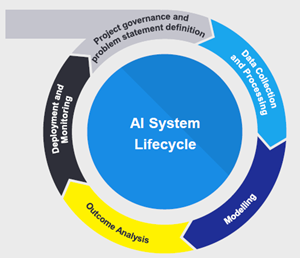
- Project governance and problem definition
- Data collection and processing
- Model design
- Validation and testing
- Implementation and monitoring
This section is the most detailed part of the Guideline and contains practical considerations highly relevant to practitioners.
d. Stakeholder Engagement and Communication
Organizations should take appropriate steps to build trust throughout the entire AI lifecycle, including:
- Disclosure of AI use, its purpose, and type of AI system;
- Employee training and job redesign to manage the impact of AI adoption, both in a positive way and a non-positive way; and
- Establishment of feedback channels regarding AI usage.
(6) Recommendations for Governments and ASEAN (Sections D and E)
a. National-Level Recommendations
- Develop AI talent and upskill the workforce
- Promote investment in AI start-ups
- Increase investment in AI R&D
- Promote tools that support implementation of the Guideline (e.g., Singapore’s AI Verify)
- Raise public awareness of AI’s societal impact
b. Regional-Level Recommendations
- Establish the ASEAN AI Governance Working Group- Transparency:
- Develop a version of the Guideline specifically for generative AI
- Compile a compendium of ASEAN-wide organizational use cases
(7) Conclusion (Section F)
The Guideline emphasizes that it represents a regional best-practice reference, developed collaboratively by ASEAN Member States under their shared objectives of economic, social, technological, and scientific cooperation.
It also reiterates that the Guideline serves as a practical reference for organizations and government agencies implementing AI systems and will be updated over time as a living document.
Its application is voluntary and does not alter any legal rights or obligations under domestic laws.
(8) AI Risk Impact Assessment Template (Annex A)
Annex A provides a risk impact assessment template based on Singapore’s Implementation and Self-Assessment Guide for Organizations (ISAGO), covering:
- Purpose of AI implementation
- Internal governance structure and processes
- Determination of human involvement
- Operations management
- Stakeholder engagement and communication
(9) Use Cases (Annex B)
Annex B presents reference cases from organizations that have implemented AI governance practices within ASEAN, including:
- Aboitiz Group (Philippines)
- Ernst & Young
- Gojek (Indonesia)
- AI (Singapore)
- Smart Nation & Digital Government Office (Singapore Government)
- Ministry of Education, Singapore
3. Summary
Although not legally binding, the Guideline is increasingly recommended for ASEAN-based organizations as a practical reference when engaging in AI-related activities. ASEAN Member States may, in the future, develop domestic regulations aligned with this Guideline, potentially drawing influence from the EU AI Act.
———-
[1] One Asia Lawyers Newsletter- AI Laws and Guidelines Around the World -Part 1: Indonesia-
[2] ASEAN Guide on AI Governance and Ethics