





Japan: Regulatory Sandbox
We published a newsletter regarding a Regulatory Sandbox in Japan. To view PDF version, please click the following link.
Regulatory Sandbox
August 20, 2025
One Asia Lawyers Group Tokyo Office
Bakuto Yamamoto, Lawyer (Japan)
Yugo Kusu, Lawyer (Japan)
In recent years, with the advancement of technology, existing laws and regulations have increasingly become significant obstacles to the implementation of new services and business models. To address these challenges, the Regulatory Sandbox was introduced. In the August 2021 newsletter, we introduced an overview of the permanent establishment of the Regulatory Sandbox. In this letter, we will once again explain the outline of the Regulatory Sandbox and introduce the cases of its implementation and new initiatives.
I. About the System
1. Purpose of the system
The Regulatory Sandbox, established in June 2018, allows for demonstration tests of new technologies such as IoT, blockchain, and robotics, as well as new business models including platform-based businesses and the sharing economy, in cases where implementation is difficult under existing regulations. Based on applications submitted by businesses, demonstration projects certified by the relevant regulatory authority can be conducted, and the information and data obtained through such demonstrations can then be used to review and potentially revise regulations.
In other words, while regulatory authorities are reluctant to pursue regulatory reform without sufficient supporting data, businesses are unable to conduct trials or obtain the necessary data due to the very existence of those regulations. The Regulatory Sandbox was created to overcome this impasse.
By limiting the duration and participants of the demonstration, the system enables businesses to conduct trials without being subject to existing regulations, thereby creating an environment for experimentation. At the same time, the system facilitates the effective use of the information and materials obtained from demonstrations to support smooth commercialization and promote regulatory reform.
2. Procedures for using the Regulatory Sandbox
The process for utilizing the Regulatory Sandbox generally involves the following steps:
(1) A business submits a demonstration plan for new technologies to the competent minister (responsible for the relevant industry and regulation).
(2) The Committee for Evaluation of New Technologies is convened.
(3) The competent minister certifies the demonstration plan.
(4) The business conducts the demonstration.
(5) The competent minister considers and implements potential regulatory revisions.
Before submitting the demonstration plan in Step 1, businesses may consult the one-stop contact office established within the Cabinet Secretariat. By doing so, preliminary coordination can be carried out between the Cabinet Secretariat and the competent minister in advance. This allows businesses to receive support during the committee’s review and subsequent consultations, thereby facilitating a smoother process overall.
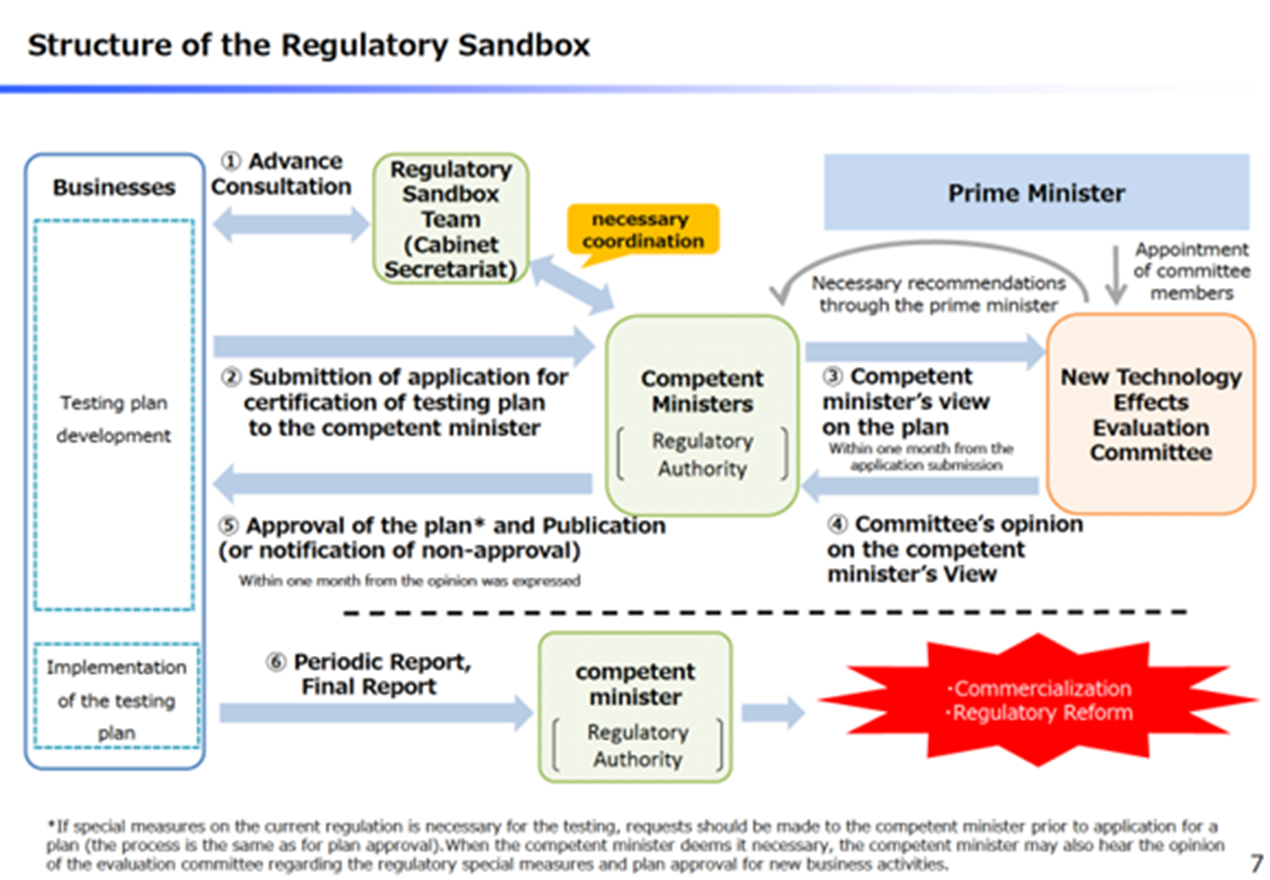
(Regulatory Sandbox Team (Japan’s Regulatory Sandbox))
II. Case Studies of Implementation
1. Demonstration on the Sale of Label-Free PET Bottles through Vending Machines
(1) One example, applied for by Coca-Cola (Japan) Company, Limited on June 2, 2023, and certified on July 19 of the same year, concerned a demonstration on the sale of label-free PET bottles through vending machines.
(2) The purpose of the demonstration was to confirm that, when selling label-free products through vending machines, displaying product information directly on the vending machines would allow consumers to access the same level of product information as they would with conventional labeled products. This would ensure food safety and the ability to make informed and reasonable choices when consuming food. Furthermore, the long-term objectives included enabling the sale of multiple label-free products through vending machines to improve the recyclability of PET bottles consumed outside the home, and reducing plastic waste and CO₂ emissions by eliminating the need for labels. Specifically, it was estimated that plastic waste could be reduced by approximately 4,600 tons per year and CO₂ emissions from labels by approximately 41,300 tons per year.
The reason for utilizing the Regulatory Sandbox was that, under existing laws such as the Food Labeling Standards (based on the Food Labeling Act), ministerial ordinances under the Act on the Promotion of Effective Utilization of Resources concerning PET bottles containing beverages or specified condiments, and the Measurement Act, beverage products are required to display certain product information. As a result, most PET bottle beverages have product information affixed as a label on the bottle itself.
(3) The demonstration plan involved installing vending machines in office locations with restricted access for a limited number of people. These machines dispensed, free of charge, both label-free natural mineral water and conventional labeled mineral water. Product information identical to that found on the labels of conventional products was displayed on posters or other spaces on the front of the vending machine. Additionally, the bottle caps clearly indicated a point of contact for inquiries, and the vending machine displayed information on how consumers could access further product details.
For the initial three months, only conventional labeled products were distributed free of charge, and the empty bottles collected in dedicated recycling boxes were examined to confirm whether labels remained attached. For the subsequent three months, both label-free and conventional products were distributed, and empty bottles were again collected in dedicated recycling boxes to check the proportion of conventional products where labels had been removed.
The demonstration sought to confirm, through surveys, whether participants recognized the product information as equivalent to that provided on conventional labeled products, and to test the hypothesis that (i) consumers would prefer label-free products over conventional ones, and (ii) when label-free and conventional products were offered simultaneously, a higher proportion of conventional bottles would have their labels removed compared to when only conventional products were offered.
(4) The demonstration continued until the end of January 2024, after which the relevant regulatory framework was reviewed.
2. Demonstration on the Use of Electric Kickboards for a Sharing Business
(1) Another example, applied for by Luup, Inc. on October 2, 2019, and certified on October 17 of the same year, involved a demonstration to test the feasibility of operating a sharing service for electric kickboards.
(2) The purpose of the demonstration was to confirm the safety and business feasibility of such a service. Specifically, the business operator aimed to:
(i) provide a new, convenient mode of transportation, and
(ii) expand mobility options for elderly people through the use of three-wheeled and four-wheeled electric kickboards.
The demonstration sought to collect knowledge on vehicle safety, traffic safety, appropriateness of vehicle management, user demand, and overall business viability, with the ultimate aim of making proposals on appropriate regulatory requirements.
The need for the Regulatory Sandbox arose from the fact that electric kickboards were classified as “motorized bicycles” under the Road Transport Vehicle Act and the Road Traffic Act. As such, they were subject to numerous requirements, including:
- a maximum speed of 30 km/h,
- prohibition on use on sidewalks or bicycle lanes (road use only),
- mandatory helmet use,
- driver’s license requirement (under the Road Traffic Act),
- compliance with vehicle safety standards (under the Road Transport Vehicle Act), and
- obligations such as taxation and displaying license plates (under the Local Tax Act, etc.).
Any vehicle or usage not compliant with these regulations would constitute a legal violation.
(3) The demonstration was conducted within a designated area on a university campus, as a free sharing service. The scheme involved:
(i) checking safety instructions at multiple designated “ports” within the area before riding,
(ii) free use of the kickboards within the designated area,
(iii) parking the vehicle at a port upon completion of use,
(iv) restricting participation to individuals aged 18 or older who were faculty, students, or otherwise affiliated with the university, and
(v) providing three- and four-wheeled models to collect and analyze data on vehicle safety, compatibility with pedestrians and bicycles, and overall safety of operation.
(4) As a result of the demonstration, amendments to the Road Traffic Act were enacted on April 19, 2022 (enforced on July 1, 2023), creating a new vehicle classification: “Specified Small Motorized Bicycles.” Under this new classification:
- the maximum speed is limited to 20 km/h,
- in addition to roads, riding is permitted in exclusive bicycle lanes and on bicycle paths,
- helmet use is recommended but not mandatory, and
- no driver’s license is required (for individuals aged 16 or older).
III. Regional Regulatory Sandbox
As a related framework to the Regulatory Sandbox, a Regional Regulatory Sandbox has been introduced under the National Strategic Special Zone Act.
Unlike the Regulatory Sandbox, which is conducted on a project-by-project basis, the Regional Regulatory Sandbox is characterized by being led by local governments. Its purpose is to enable demonstration experiments involving advanced and innovative near-future technologies—such as autonomous driving, unmanned aerial vehicles (drones), and radio wave utilization associated with these technologies—to be conducted more swiftly and smoothly within designated special zones.
Within these National Strategic Special Zones, the system minimizes prior regulatory restrictions while strengthening post-facto monitoring and evaluation mechanisms.
In municipalities such as Tokyo, one-stop centers for near-future technology demonstrations have been established. These centers coordinate with relevant ministries and local police authorities, providing centralized support for demonstration projects. Similar to the one-stop contact office of the Cabinet Secretariat under the Regulatory Sandbox, businesses can consult the one-stop center without the need to individually contact each relevant authority, thereby streamlining the consultation process.
IV. Conclusion
As described above, the Regulatory Sandbox serves as a framework that allows businesses to “try first,” enabling the prompt demonstration of new technologies and business models.
Since its establishment in June 2018 up until March 19, 2025, a total of 33 projects involving 152 entities across diverse fields have been certified under the Regulatory Sandbox.
Going forward, the Regulatory Sandbox is expected to expand in use as one of the effective approaches—together with mechanisms such as the Grey Zone Elimination System—for requesting regulatory reforms and launching new businesses.