






Japan: Digitalization of Procedures Related to Notarial Deeds
We published a newsletter regarding Digitalization of Procedures Related to Notarial Deeds in Japan. To view PDF version, please click the following link.
→Digitalization of Procedures Related to Notarial Deeds
Digitalization of Procedures Related to Notarial Deeds
October 16, 2025
One Asia Lawyers Group Tokyo Office
Bakuto Yamamoto, Lawyer (Japan)
Yugo Kusu, Lawyer (Japan)
A notarial deed (kōsei-shōsho) is a public document prepared by a notary public, who is a civil servant, acting under statutory authority at the request of a private party. The merits of a notarial deed include that it constitutes highly persuasive evidence of facts, and that, where it contains a consent-to-enforcement clause, compulsory execution may be carried out directly on the basis of that deed, among other advantages.
Previously, the preparation of a notarial deed required the parties to appear in person at a notary office, which imposed certain burdens on the users. However, the Notary Act amendments, which was a part of the “Act on the Development of Laws to Promote the Utilization of Information and Communications Technology in Civil Proceedings (Act No. 53 of 2023, and promulgated in 2023)”, came into effect on October 1, 2025, making it possible to prepare notarial deeds by remote means. In addition, following the amendments to the Notary Act, notarial deeds can now be produced not only in paper form but also as electronic data.
Below, in Section 1 summarize: (1.1) the outline of the preparation of notarial deeds in electronic data form; (1.2) the outline of the preparation of notarial deeds by remote means; (1.3) requests submitted via the Internet; and (1.4) changes to fees. In Section 2 elaborate on item (1.2) above and discuss in greater detail the requirements applicable to the remote method.
1. Overview of the New System
1.1 Preparation of Notarial Deeds in Electronic Data Form
1.1.1 Previously, notarial deeds were prepared only in paper form, and the version written within the ruled lines of the notarial paper was regarded as the original.
Following the amendments to the Notary Act, in addition to preparation in paper form, it has become possible to prepare notarial deeds in electronic data form. As a general rule, notarial deeds are now to be prepared and stored in electronic form.
When prepared electronically, a document created in Microsoft Word and converted into a PDF file is treated as the original.
The following outlines the procedural flow for preparing a notarial deed in electronic data form.
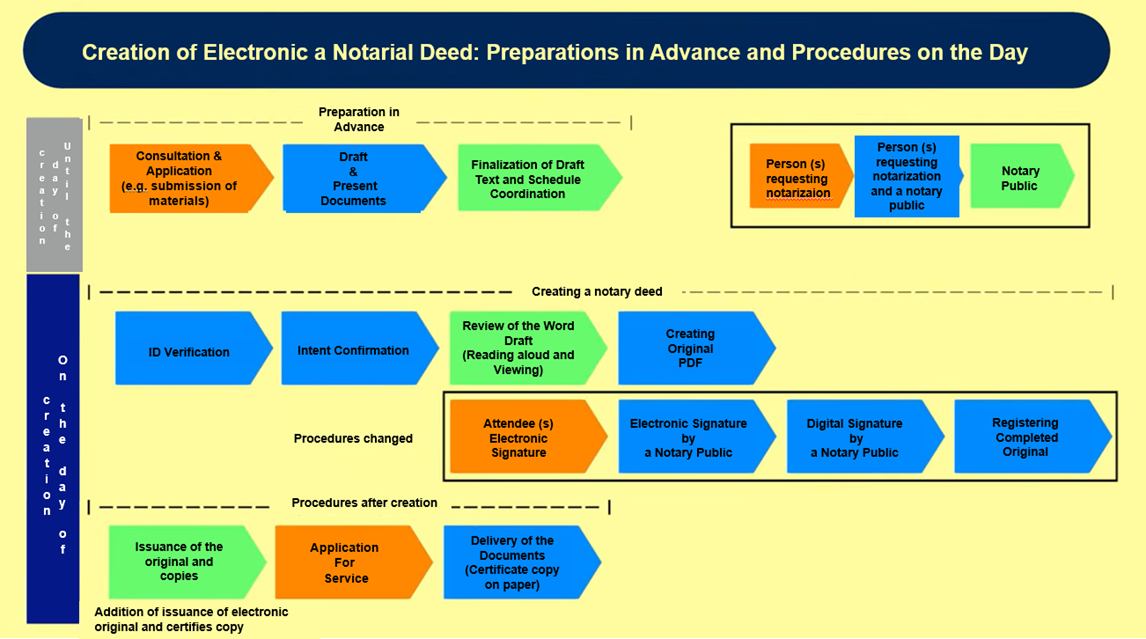
(Retrieved from the Video created by Japan National Notaries Association「電子公正証書の作成(PART1)「法改正の概要と対面方式の電子公正証書作成」(only in Japanese))
In cases where a notarial deed is prepared in electronic form, the notary public reads aloud the draft prepared in Microsoft Word to confirm its contents, and attendees then review the contents of the draft, either by viewing a printed copy prepared for them or by viewing the same draft displayed on a monitor for attendees.
Once this confirmation process is completed, the notary public generates from the Word draft a PDF file that will serve as the original. The attendees affix their electronic signatures, and the notary public affixes both his or her electronic signature and digital signature. The completed original is then registered in the electronic system.
After a notarial deed has been prepared in electronic form, an original and other counterparts are issued. In the case of an electronic original or transcript, delivery is made by providing a medium such as a CD-R containing the burned data.
1.1.2 When preparing a notarial deed in electronic form, the signatures are changed from handwritten signatures to electronic signatures (that is, the name of the signer written using a stylus on a touch-sensitive display or pen tablet and embedded in the PDF file).
The notary public’s seal, in turn, becomes a digital signature, which is embedded in the PDF file, and if the data is altered after the digital signature has been applied, such alteration will be automatically indicated.
Accordingly, in the preparation of a notarial deed, the person (s) requesting notarization affixes an electronic signature, while the notary public affixes both an electronic signature and a digital signature.
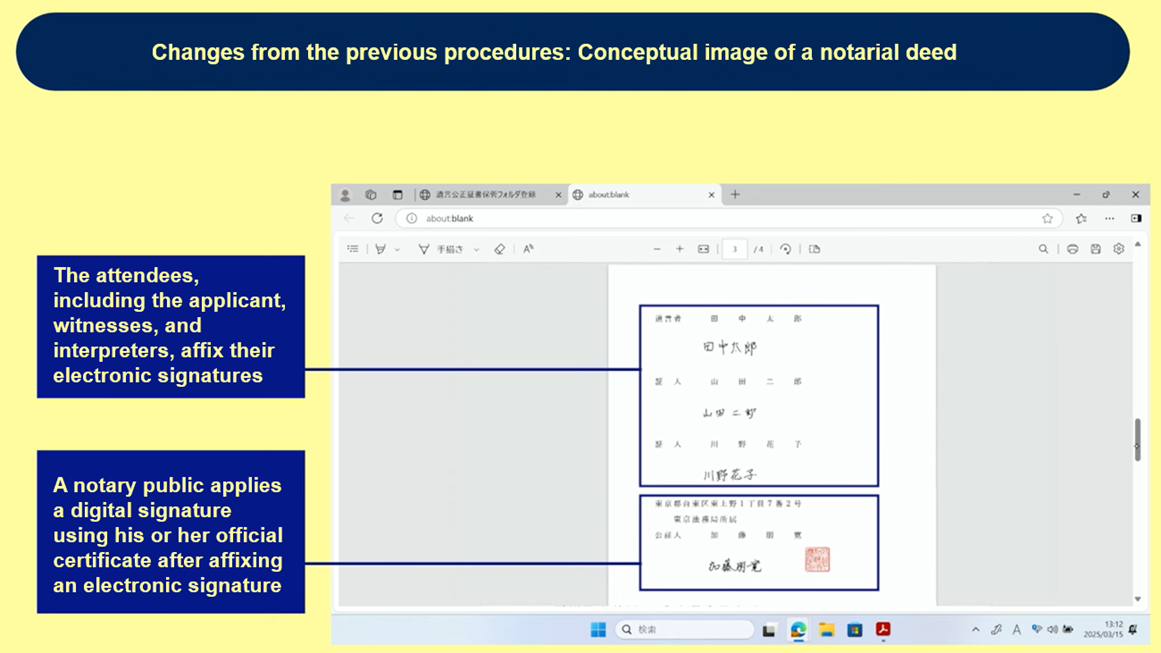
(Retrieved from the Video created by Japan National Notaries Association「電子公正証書の作成(PART1)「法改正の概要と対面方式の電子公正証書作成」(only in Japanese))
1.1.3 In cases where a notarial deed is prepared in person but in electronic form, no special preparations are required on the part of the person requesting notarization due to the use of electronic methods. The notary public will undertake the necessary establishment of systems and preparation of equipment required for digitization.
1.2 Preparation of Notarial Deeds by Remote Means
1.2.1 In addition to the traditional method of preparing a notarial deed through in-person attendance before a notary public at a notary office or similar facility, it has now become possible to prepare a notarial deed by participating in a web-based conference from outside the notary office.
As a result, attendees may now participate from outside the notary office using their own personal computers (although it is also allowed for multiple attendees to participate jointly using a single computer). It is likewise allowed for some of the attendees to participate from within the notary office itself, using a computer reserved for the exclusive use of the notary public.
1.2.2 When the remote method is used, the following requirements must be satisfied:
A) That the person (s) requesting notarization or his/her representative has made a request to use the remote method;
B) That there is no objection by the other party to the remote participation of the person (s) requesting notarization or representative;
C) That the notary public considers the remote participation of the person (s) requesting notarization or its representative to be appropriate; and;
D) That the use of the remote method is permitted under the relevant laws and regulations.
With respect to item B above, it is considered appropriate that, as to interpreters and witnesses, the intention of the person (s) requesting notarization who requires assistance or the presence of a witness be given priority, and therefore the existence or absence of objections by other requesting parties is not to be taken into account.
Item C will be explained in further detail in section 2 below.
As for item D, certain categories of notarial deeds are excluded. For example, a notarial deed of declaration of intention to guarantee is excluded from the scope of the remote method because its purpose differs fundamentally from that of ordinary notarial deeds, which are prepared mainly for the prevention of future disputes (Article 37.3 of the Notaries Act).
1.2.3 The procedural flow on the day of preparation of a notarial deed by the remote method is as follows:
1.2.3.1 First, an attendee joins the meeting (Microsoft Teams) via an invitation email. A notary public then verifies the communication status for both sending and receiving. During this step, for the purpose of confirming the environment, the notary public may request that an attendee use a web camera to show the location from which they are attending remotely.
1.2.3.2 Next, an attendee displays a photo-bearing identification document on screen, and the notary public compares the photograph on the document with the attendee’s face shown on the screen, asking any necessary questions to confirm the person’s identity. With the attendee’s consent, the notary public captures and stores a screenshot of the identification document as displayed.
1.2.3.3 After confirming the person’s identity, the notary public verifies the attendee’s intent. The notary public then shares the Word draft of the notarial deed on screen and reads it aloud.
1.2.3.4 Once the contents have been reviewed and confirmed, the notary public generates a PDF file to serve as the original.
1.2.3.5 Each attendee then affixes his or her electronic signature. For this purpose, an email requesting electronic signature is sent to each participant in turn; each participant opens the Word draft as guided in the email, reviews it while sharing their screen, and then affixes their signature. The notary public thereafter affixes his or her electronic signature and digital signature, and proceeds with the procedures for delivery of the electronic authenticated copy and related documents. Specifically, the notary public uploads the PDF file serving as the original to a designated download site and sends the URL to each participant by email. At the same time, a password is communicated through Microsoft Teams. Each attendee inputs the password, downloads the electronic authenticated copy or transcript, and sends an acknowledgment email of receipt to the notary public.
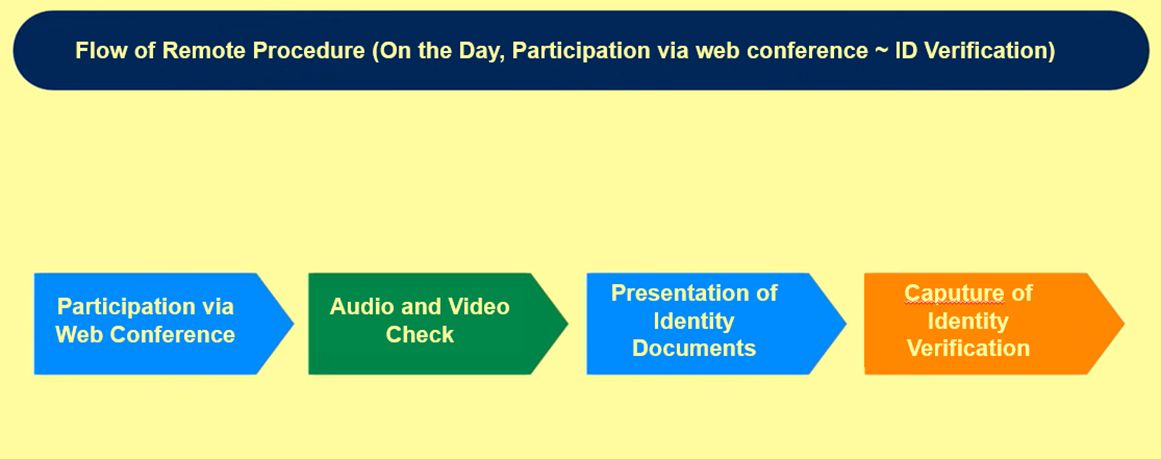
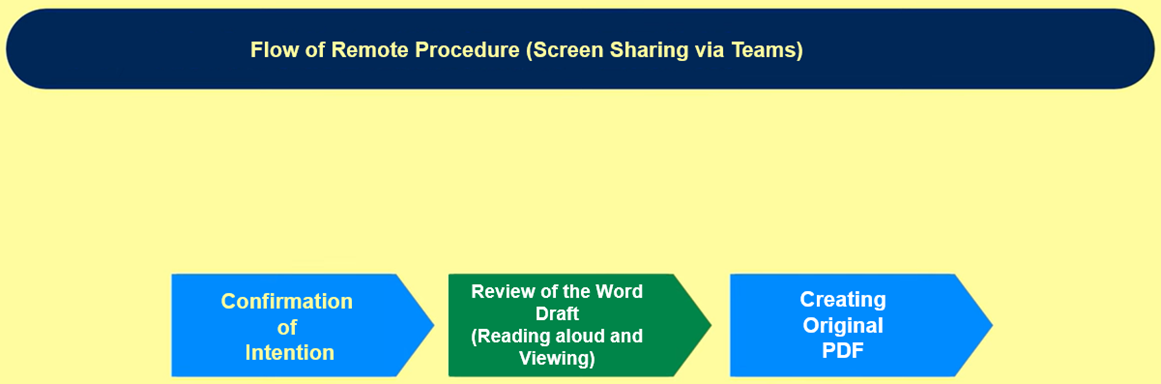
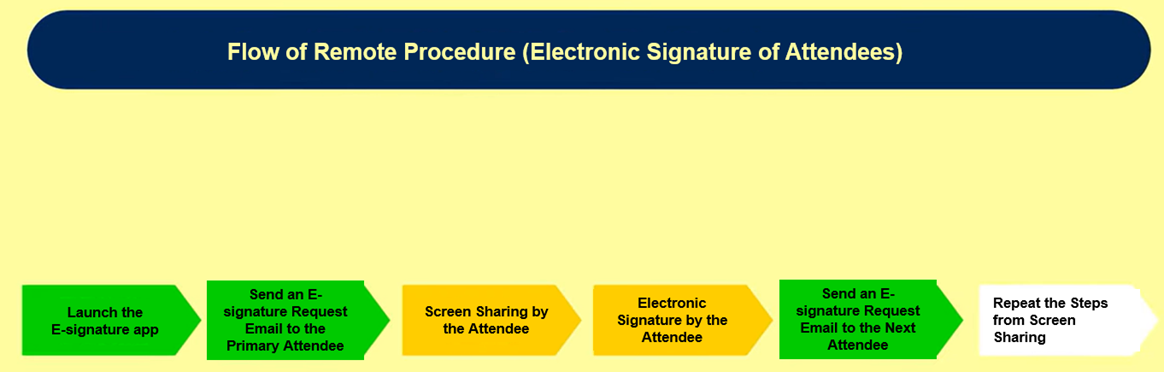
(Retrieved from the Video created by Japan National Notaries Association「電子公正証書の作成(PART2)「リモート方式による作成」(only in Japanese))
1.2.4 When using the remote method, attendees must prepare their own personal computers. As noted above, because screen-sharing is required, smartphones and tablets are not permitted. A web camera, microphone, and speakers are also required, although those built into a computer may be used. In addition, since the process requires affixing an electronic signature, a display capable of touch input or a pen tablet together with an electronic stylus must be prepared. Furthermore, an email address capable of receiving messages on the computer to be used must be available.
1.3 Requests by Internet
Previously, it was necessary to appear in person at the notary office to submit a request. Under the revised law, however, it has become possible to submit a request without appearing in person by sending it via the Internet. Specifically, the person (s) requesting notarization electronically signs the data (containing the information related to the request) and attaches an electronic certificate, allowing identity verification to be conducted electronically through email submission over the Internet.
1.4 Revision of Fees
The main changes are as follows:
A) that the fee has been reduced in cases where the value of the object of the legal act is 500,000 yen or less;
B) that the fee for the preparation of notarial deeds concerning arrangements for child support and entrustment of posthumous affairs has been reduced; and
C) that the fees for the preparation of other notarial deeds have been reviewed.
For details, please refer to the following.
・公正証書の手数料の見直しに関するリーフレット (Only in Japanese)
2. Requirement for the Remote Method
2.1 As described in 1.2.2, in order to conduct the remote method, it is necessary to satisfy requirements (A) through (D). Requirements (A), (B), and (D) are relatively clear; therefore, the following explains requirement (C), “that the notary public considers the remote participation of the person (s) requesting notarization or its representative to be appropriate.”
2.2 The appropriateness of the remote method is judged comprehensively by taking into account necessity and permissibility. Each of the factors considered is as follows:
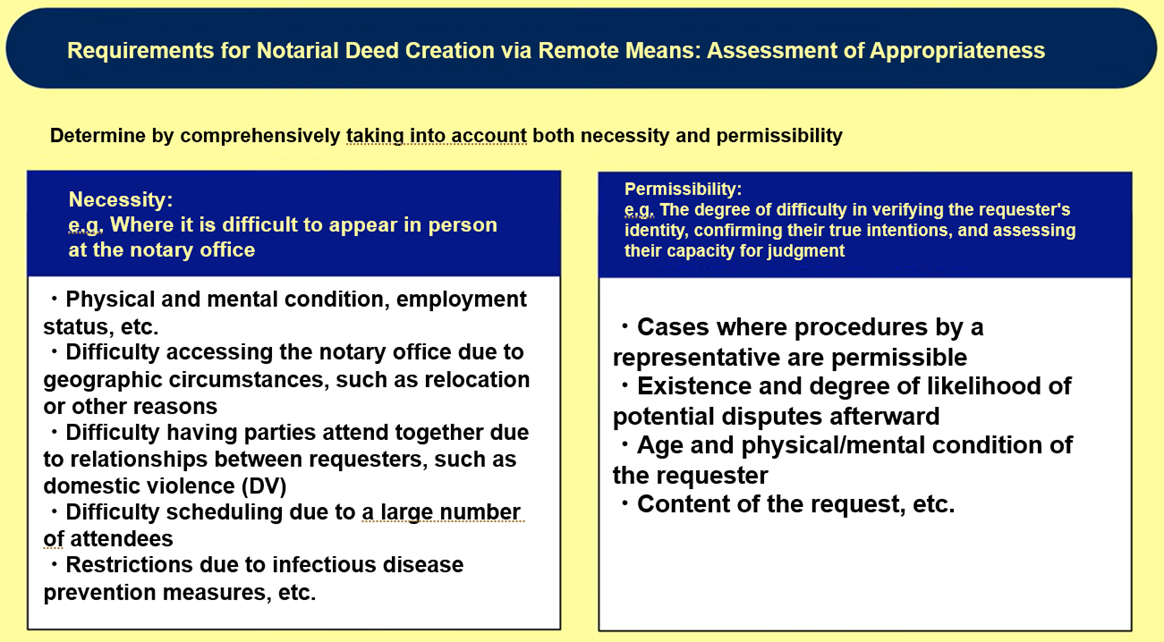
(Retrieved from the Video created by Japan National Notaries Association「電子公正証書の作成(PART2)「リモート方式による作成」(only in Japanese))
2.2.1 Regarding necessity, it can be accepted to a certain degree that a request for the use of the remote method exists. In addition, when circumstances such as those shown in the column “necessity” of the figure above exist, a higher degree of necessity is recognized.
2.2.2 Regarding permissibility, the central factor for judgment is whether identity verification and confirmation of true intention of the requester can be properly conducted by means of a web conference[1].
Among these, confirmation of true intention and the underlying decision-making capacity is considered as follows according to category:
| 【Category】 Notarial deeds used for business purposes, for which a request by agent is permitted |
【Permissibility】 The use of web conferences may be widely permitted. |
||
| Notarial deeds for wills | Under current law, the preparation of a notarial deed for a will by an agent is not permitted. Therefore, careful judgment is required. However, the degree of caution varies depending on the testator’s age, physical and mental condition, contents of the will, and circumstances leading up to the request. For cases not falling under the specific types below, the appropriateness is judged by considering which type they are closest to. | ||
| 【Type】 | 【Example】 | 【Permissibility】 | |
| Will with high likelihood of posthumous dispute | A will by a person with likely impaired testamentary capacity (elderly, diagnosed with illness affecting capacity), a will leaving all assets to only some of multiple presumed heirs without reasonable grounds, etc. | Judgment requires particular caution. Measures must be strictly implemented to prevent involvement of interested parties, and remote participation should only be recognized when a higher degree of necessity exists. | |
| Will with low likelihood of posthumous dispute | A will by a middle-aged testator, a will by a testator without heirs leaving assets to a charitable organization, a will by an elderly person whose capacity can be objectively confirmed by a doctor’s certificate, etc. | Special caution is not required. | |
| Notarial deed for a voluntary guardianship contract | In practice, the notary public is required to meet the requester directly. Similar to the will, careful judgment is necessary. The degree of caution varies depending on the age, physical and mental condition, contents of the contract, and circumstances leading up to the request. Furthermore, it is necessary to carefully determine whether the requester correctly understands the content and purpose of the voluntary guardianship contract. | ||
2.3 As described above, the appropriateness of the remote method is judged by necessity and permissibility.
The amended law came into effect on October 1, 2025, and the operation of preparation of notarial deeds by the remote method has commenced.
Therefore, it is necessary to monitor future practical trends regarding the concrete operation.
—–
[1] The following is from the summary of the Report of the Ministry of Justice, Civil Affairs Bureau, “Council with Practitioners on the Digitalization of Notarial Practices” (法務省民事局「公証実務のデジタル化に関する実務者との協議会 報告書概要」)
議論のとりまとめの概要 (Only in Japanese)